Superposition Noisy Network Coding
Using the technique of superposition encoding, partial decode and forward is combined with noisy network coding. This hybrid scheme is termed as superposition noisy network coding. The scheme is designed and analyzed for the discrete memoryless single relay channel shown below.
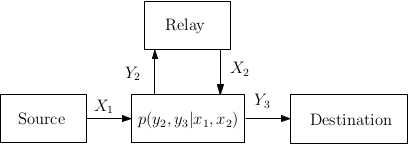
The main result of the work is the following achievability theorem for the discrete memoryless single relay channel using superposition noisy network coding.
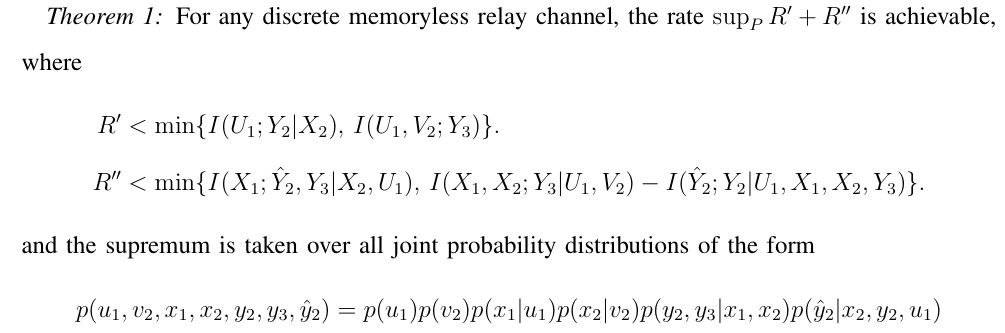
The Key ideas are:
- Improve the achievable rates of the noisy network coding scheme by allowing the nodes to decode a part of message and use the message to make a better compressed signal to be relayed.
- The message at each node is split in two parts. A part of the message is required to be decoded at each relay after every block. The other part of message is transmitted over b blocks using repetition coding. The relay nodes use compress-forward to transmit this message.
- The destination nodes decode the messages after b blocks of transmission using joint decoding.
- Similar to noisy network coding, our scheme does not use Wyner-Ziv encoding at the relay, employs repetition encoding for a part of the message and uses joint decoding.
The special cases of Gaussian single relay channel is analyzed for superposition noisy network coding. The achievable rate of the proposed scheme for the Gaussian relay channel is same as the superposition forward scheme. The scheme is easily extendable to the network case and promises higher achievable rates than the existing schemes.