Relay Channel
The Gaussian relay channel shown here forms the fundamental building block for multi-user information theory. The channel capacity of this simple three node network is still unsolved for more than 30 years. Many coding schemes have been proposed which achieve rates within constant bits to the cut set upper bound.
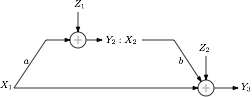
Our work analyses the achievable rate of the superposition of block Markov encoding (decode-forward) and side information encoding (compress-forward) for the three-node Gaussian relay channel. It is generally believed that the superposition can out perform decode-and-forward or compress-and-forward due to its generality. We prove that within the class of Gaussian distributions, this is not the case: the superposition scheme only achieves a rate that is equal to the maximum of the rates achieved by decode-and-forward or compress-and-forward individually.
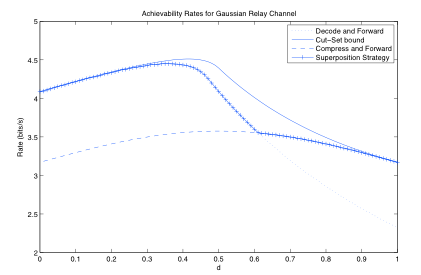
The graph shows the rates achieved by different encoding schemes as a function of normalized relay distance from the source. It can be observed that the superposition forward scheme achieves the maximum of rates achieved by compress-forward or decode-forward.